Help us keep a strong, reasoned, and uncensored voice for Israel alive.
Dear Friends,
In times like these, clear, factual, and courageous voices for Israel are more important than ever. The mission of Israpundit has always been to share truth, defend Israel against misinformation, and give readers a place to find clarity and conviction.
Drawing a sharp line in the sand, Milei announced that Argentina is abandoning historical neutrality to unequivocally align itself with the West, the United States, and Israel, modeling a future based entirely on free enterprise, private property, and limited government. [1, 2, 3, 4, 5]
On November 1st, the antisemitic propaganda film “NAZA” will begin its large-scale international distribution.
A massive worldwide release of this film is expected, which could turn it into a major propaganda attack against the Jewish people, Israel, and IDF (Tsahal) soldiers.It is imperative to get ahead of the lies before they spread all over the world!
Donald Trump speaking at CPAC in Washington D.C. on February 10, 2011. Photo by Gage Skidmore, CC BY-SA 3.0, Wikipedia
In the 1960s, I started out as a liberal because all those fuzzy feelings that leftist doctrine aroused in me “felt” virtuous and empathic and in sync with my desire to be a good person.
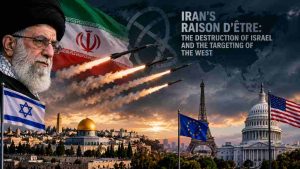
Peloni: Washington’s depiction of the potential of an Iranian attack on Israel is completely misguided. The threat of an Iranian attack is not related to Israel’s recent display of force nor to Bibi’s campaign ad, nor to any action taken by Israel or America.
Any Iranian attack on Israel, whether it comes today, tomorrow, next week or next year, no matter if it follows American threats or Israeli posturing, it will come because the annihilation of Israel is its raison d’être. Included in this raison d’être is its need, not want, but need to target and subject the entire Western world as well, including America. So, no matter if Iran attacks Israel, or Europe or America, it will not come because of any action taken by these elements of the West, but because they still exist as elements of the West. Washington needs to learn this lesson the easy way before it is taught the reality of this fact after they are in turn targeted by the annihilistic ideologues in Tehran which too many in Washington still fail to appreciate exist as an existential threat to both the American govt and the American people.
Netanyahu published the image ahead of Israel’s elections on Tuesday, focusing on the nuclear threat from Iran.
US officials feared an AI-generated image shared by Prime Minister Benjamin Netanyahu showing Tel Aviv under Iranian nuclear attack could be interpreted by Tehran as a sign that Israel was preparing an imminent strike, N12 reported.
PELONI: This report covers an important telling of the last minute strategies between the parties, but I still challenge that the preference to ignore what I see as the likely more accurate polling as reported on Channel 14 will lead to the same post election surprises as was found to be remarkable by one and all in 2022, all but Channel 14 of course whose polling did establish that Bibi would win the election prior to the election. Time will tell of course.
The day before Israel’s Tuesday elections, party campaigns went into overdrive in a last-ditch effort to persuade undecided voters and maximize turnout among their respective bases.
PELONI: An armed public can prevent disasters from occurring, or prevent a serious disaster from becoming even more tragic. Stay armed, stay trained, stay alert, and provide the security that your family and community need until the authorities are able to arrive. In Jordan, a recent terror attack on a Christian funeral procession at a Greek Orthodox Church saw a delay of some 45 minutes for the authorities to arrive. In that time one armed citizen could have provided a meaningful deterrence to the slaughter that ensued. Recall the slaughter at Bondi Beach with this same reference in mind. An armed public provides a serious deterrence to a successful terror attack, no matter the location or nation in which such terror attacks take place. Of course, totalitarian govts fail to appreciate the strength inherent in allowing the public to be armed.
“I told myself this is probably the last thing that I’m ever going to do.”
by Daniel Greenfield | October 25, 2026
Click Image to Enlarge. Image created via AI.
According to the gun control lobby, there’s no possible way an armed civilian can possibly stop a mass shooting. It’s best just to wait for the police who will then form a cordon and arrest any parents who try to save their children, and after having lunch, and checking the news on their phones, and making sure all the kids are dead, finally get off their asses, put on all their DHS grant SWAT gear and go in.
A newly publicized Hamas document suggests that senior leaders of the terrorist organization discussed canceling their planned assault on Israel months before the October 7, 2023, massacre if Israel met certain conditions concerning the Al-Aqsa Mosque and jailed Palestinian terrorists.
PELONI: Pay attention to the words of our detractors. They care not what party or leader controls our state. The very existence of the Jewish state, it will be treated as the Jew among the states with double standard and deligitimization based on nothing more relevcant than that Jew Hatred is at the root of all of it.
The demonization of Israeli leaders reveals a hostility not to Netanyahu, but to Israel’s existence.
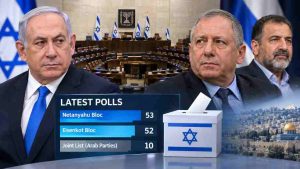
Israelis will vote on Tuesday for a new Prime Minister for the first time since October 7th. The final polls show Gadi Eisenkot’s Yashar party ahead of Benjamin Netanyahu’s Likud, with neither able to reach a majority on its own.
PELONI: Pollard reveals many important measures which exist at the core of making Israel a self reliant and independent nation, but the reality is that for these measures to be adopted it will come at a serious cost to Israel. The sanctions war raised against Israel from Europe need only gain the tolerance of this would be significantly increased if America were to weigh in on such an economic war against Israel, something which was tested under the Biden administration.
So while Pollard’s recipe for independence is accurately described, he is missing the very element which would allow Israel to act with the impunity against the will of foreign nations, allies and enemies alike, and that element requires some out of the box thinking which Bibi only recently addressed with the call for creating a sanctions free economy, which we will no doubt come to hear more about in the coming months if Bibi is reelected in tomorrows election.
With no credible international commitment to forcibly disarm Hamas, Israel must annex Gaza rather than rely on temporary military control or unenforceable security guarantees.
The question of “the day after” in Gaza has moved from theoretical debate to unavoidable reality, forced by a stark admission from Prime Minister Benjamin Netanyahu.
El-Sayed’s issues are manifold. The problem is not his faith; it’s his policy positions and record.
Leonard Grunstein |
Click Image to Enlarge. Image created via AI.
I had the privilege of seeing then US Senator John F. Kennedy ob”m, when he was successfully running to become the President of the United States, in 1960, on Eastern Parkway in Brooklyn, NY.
PELONI: My summary of the below video can be found below Ury Weiss’ comments. The video is half an hour long with English subtitles Please share this widely.
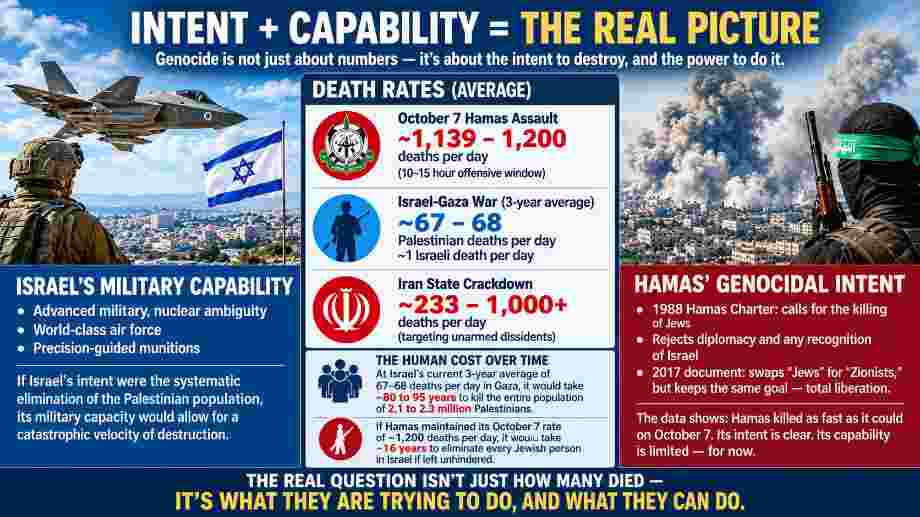
Under the 1948 Genocide Convention, the ultimate legal threshold for the “crime of crimes” rests on a singular concept: intent to destroy, in whole or in part, a protected group. In modern discourse, critics often look strictly at the raw asymmetry of casualties in the Middle East to level accusations of genocide against Israel. Yet, an objective analysis of military capability, population demographics, and explicit founding doctrines reveals that a group’s ambitions—paired with the arithmetic of violence—tell a completely different story.
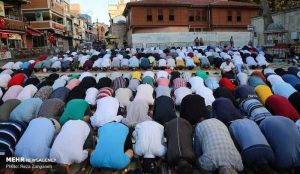
Muslims perform the Eid Al-Adha prayer at Eyup Sultan Mosque, Reza Zanganeh, Creative Commons Attribution 4.0
What did anyone expect? The answer to that is obvious: numerous non-Muslims, abjectly ignorant of the texts and teachings of Islam, think that Islam preaches peace and tolerance, because they’ve been taught that it’s “Islamophobic” to suggest otherwise. They will be shocked beyond measure when they discover that Salah Al-Sawy represents the broad Islamic mainstream, as they’ve been thoroughly indoctrinated to believe that the likes of him is only a “tiny minority of extremists.” It is not true, and was never true.
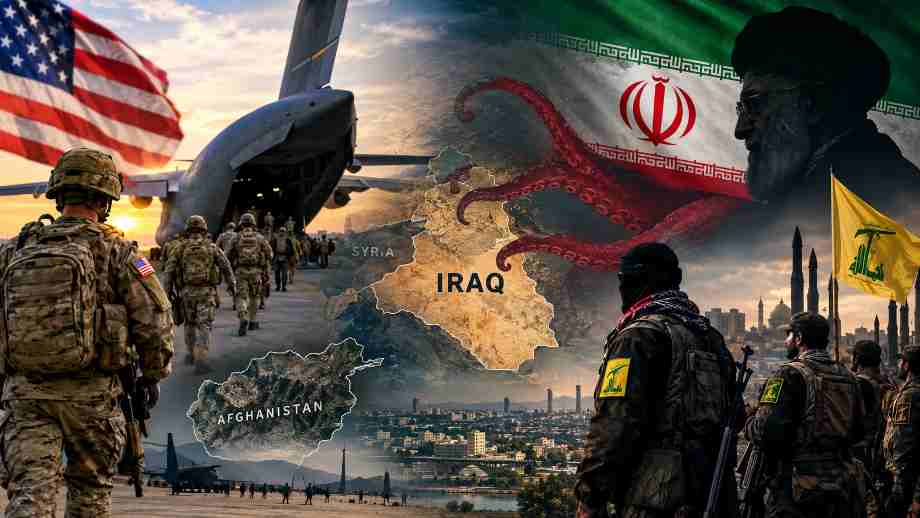
PELONI: I have made this point before. America left Iraq based on a time table rather than based on Iraq being able to demonstrate its ability to prove itself competent to rule itself, which it has since demonstrated the opposite. The consequence of this leaves the region less stable and American interests less secure, all to the advantage of America’s Iranian antagonists in the region and Iran’s masters in China.
Five years after the chaotic withdrawal from Kabul, US forces have completed their pullout from Iraq, leaving the country vulnerable to Iran-backed Shiite militias. Washington’s attempt to export democracy has failed, the Kurds have once again been abandoned, and Jerusalem fears a growing threat from the east.
by Prof. Eyal Zisser | October 25, 2026
Click Image to Enlarge. Image created via AI.
Exactly five years after American forces made their desperate escape from Afghanistan, leaving the country in the hands of the Taliban, Iraq’s turn came at the end of last month.